
FAQ’s: About Hypnotherapy | My Credentials.
-
According to the Hypnotherapy Council, hypnotherapy is a professional therapeutic approach -utilising guided relaxation and focused attention - to facilitate a state of heightened suggestibility. This state supports positive changes in an individual’s thoughts, feelings, and behaviours.
-
Yes, hypnosis is considered a safe therapeutic practice when carried out by a trained and certified hypnotherapist.
You remain in control at all times and cannot be made to do anything against your will.
-
No. Hypnosis needs dialogue to continue. The hypnotic state can be terminated at any time you choose.
You create the hypnotic state (self-hypnosis), and therefore you can bring yourself out at any time you wish.
-
Not necessarily.
Each session is tailored to your specific needs and goals, so your experiences may differ.
Some sessions may feel deeply relaxing, while others may feel more focused or insightful.
-
The Hypnotherapy Council defines hypnosis as a natural, focused state of awareness where the mind is calm, relaxed, and more open to constructive suggestions, while the individual remains fully aware and in control.
-
The Hypnotherapy Council notes that research demonstrates hypnotherapy’s effectiveness for addressing anxiety, stress, pain management, and habit change, although outcomes can vary between individuals.
-
No! Hypnosis is a conscious state. It is a focused state of attention. If you were unconscious, you would not be able to follow the hypnotist’s instructions.
However, some people may drift naturally into sleep, as it is very relaxing.
-
Yes. You are in control always. You can reject any suggestions you do not wish to accept.
You can re-alert yourself immediately and without direction from the hypnotist at any time.
You would not do or say anything during a hypnosis session that you did not want to.
-
It varies from person to person. Some people remember parts and others nothing at all.
There is no need to have a conscious recollection of the session for change to occur.
-
Hypnosis does not force you to revisit any memories against your will.
While it can sometimes facilitate access to past experiences, a professional hypnotherapist will guide the session respectfully and at a pace that feels safe for you.
-
Hypnotherapy can assist people with a wide range of issues, including:
Stress and Anxiety Management – Reducing everyday stress and easing anxiety symptoms.
Phobias and Fears – Addressing fears such as flying, spiders, or public speaking.
Insomnia and Sleep Problems – Improving sleep quality and establishing better sleep habits.
Smoking Cessation – Supporting individuals to quit smoking and maintain long-term success.
Weight Management – Helping change eating behaviours and develop a healthier relationship with food.
Pain Management – Assisting with chronic pain, migraines, or post-operative discomfort.
Confidence and Self-Esteem – Boosting personal confidence and self-worth.
Performance Enhancement – Improving focus and motivation for work, sports, or exams.
Habit Control – Tackling unwanted habits such as nail-biting or teeth grinding.
Emotional Healing – Supporting recovery from grief, trauma, or emotional blocks.
Hypnotherapy works by accessing the subconscious mind, promoting positive behavioural changes and emotional well-being.
-
According to the guidance provided by the hypnotherapy council - hypnotherapy and hypnosis are generally considered safe when conducted by a qualified practitioner.
However, there are important contraindications and cautions to be aware of:
Psychotic Disorders
Individuals with conditions such as schizophrenia, bipolar disorder (during acute episodes), or other severe psychiatric disorders may be unsuitable for hypnotherapy.
If you have, or suspect you have, one of these conditions, it is essential to consult your GP or mental health professional before considering hypnotherapy.
Hypnotherapy should only be pursued with medical approval and in collaboration with your healthcare team.
Important: Please read my full disclaimer before undertaking any form of hypnotherapy.
This information is for general guidance only and does not replace professional medical advice.
-
The number of sessions depends on the nature of the issue and individual response.
Some clients experience improvement within a few sessions, while others may benefit from a longer treatment plan.
-
The state of hypnosis is 100% real and has been scientifically proven using EEG machines to monitor the brainwaves of subjects during hypnosis.
-
Experiences vary from person to person, but many people report feeling deeply relaxed, refreshed, and calm.
Some may also experience a sense of mental clarity or lightness after a session.
-
Yes. The only requirement is the desire to be hypnotised (or at least allowing it to happen), plus an understanding of what you need to do to achieve the hypnotic state (follow direct suggestions).
The level of hypnotic depth varies from person to person. Most therapy sessions do not require more than a light trance state.
-
It is very subjective; however, most people say they feel calm and deeply relaxed, even though they were very aware of everything happening around them.
Everyone’s experience is different, and this experience will vary from session to session.
Hypnosis is a natural state. You experience it several times a day.
You can achieve it without the aid of a hypnotist (self-hypnosis). It is the state just before awakening and before drifting into sleep. It is when you are daydreaming or when you ‘zone out’ when you do tasks that involve no active thinking.
Some people find it initially hard to “switch-off” in the initial session. However, you might find it easier in subsequent sessions. Relaxation is not a prerequisite for hypnosis to be effective. Mostly, a light trance is all that is needed. There are many ways to induce a hypnotic trance state and it just might be a question of finding the style that suits you best. Being hypnotised might not feel as you expect it to, but this does not mean that you are not in a state of hypnosis.
-
No. Although, this is a common fear expressed by most people. It is just as easy to lie in hypnosis, as it is out of hypnosis. You will never do or say anything that you do not want to.
-
What is the conscious mind?
The conscious mind is the part of the mind that we are aware of the most. The part responsible for logic, reasoning, decision-making, and willpower. The decisions the conscious mind makes can be quite flawed since it is dependent on the quality of information supplied.
What is the subconscious mind?
It is the part of the mind that is mostly below the level of our awareness. It is responsible for ideomotor responses and memories (along with many other functions). It is the area where all our memories and feelings reside. Memories trigger emotions. Hypnotic suggestion is used to access the subconscious mind.
My Qualifications | Credentials.
Professional Hypnotherapy Training
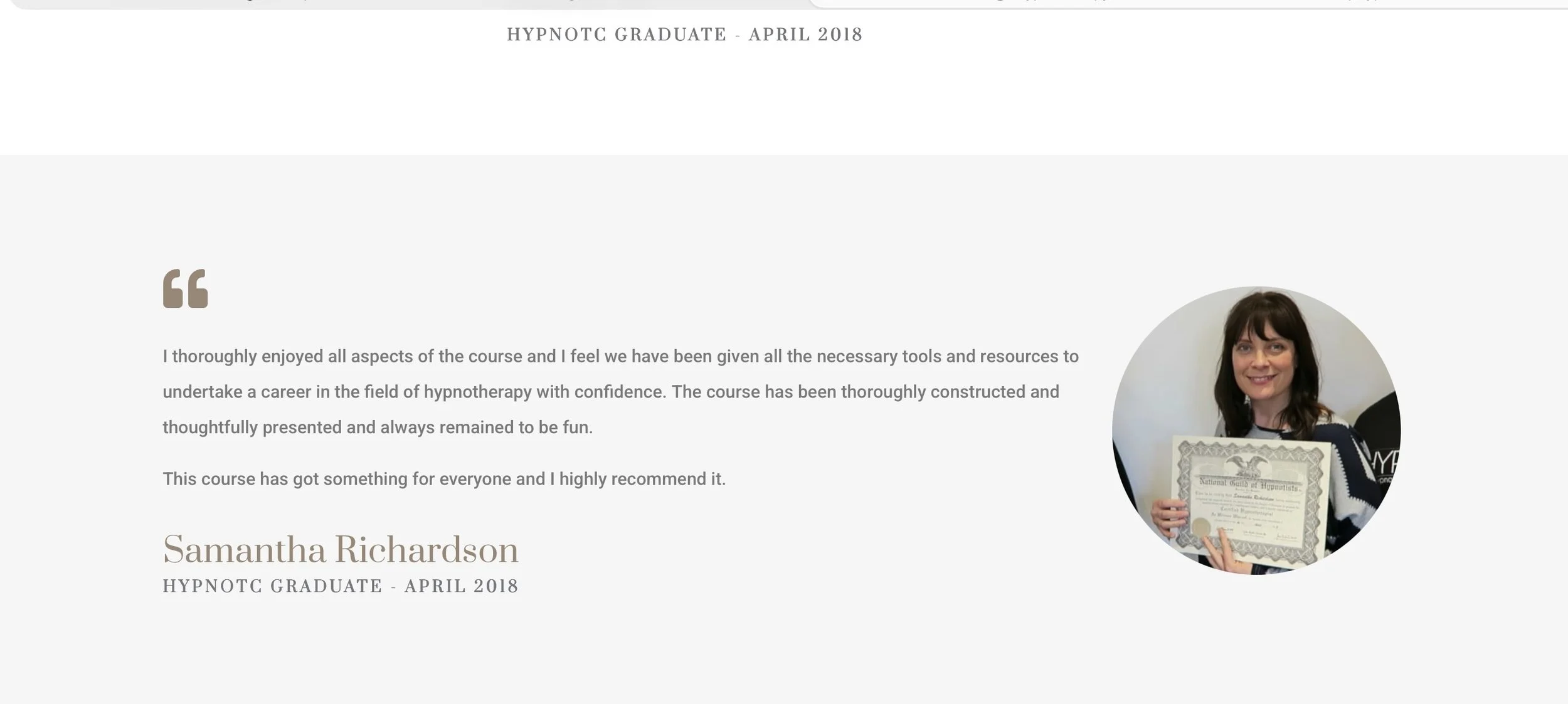
I am a Certified Clinical Hypnotherapist. Trained by HypnoTC, London, UK in 2017-18, and Certified by The National Guild of Hypnotists, USA.
HypnoTC was established in 2015 and has grown to be recognised as a provider of world-class hypnotherapy training. Dr Kate Beaven-Marks, who has over 25 years’ experience in the hypnosis industry, leads on all HypnoTC hypnotherapy training courses.
Within the course syllabus I studied: Cognitive and Behavioural Coaching - (NLP - ACT - REBT) - Mindfulness - Inner Child and Regression.
Further Training & CPD Courses:
July 1999 – Physiatrics (Massage / Body Therapies)
July 1999 – Aromatherapy
Nov 2025 – Reiki Second Degree
Jan 2013 – Emotional Freedom Technique
CPD – July 2018 – EMDR for Hypnotherapists
CPD – June 2020 – Spiritual Life Coaching Diploma
CPD – July 2021 – Meditation Teacher Diploma
If you have any other questions - please reach out - I’m here to help.